Huckleberry Finn and the Man Who Made Him
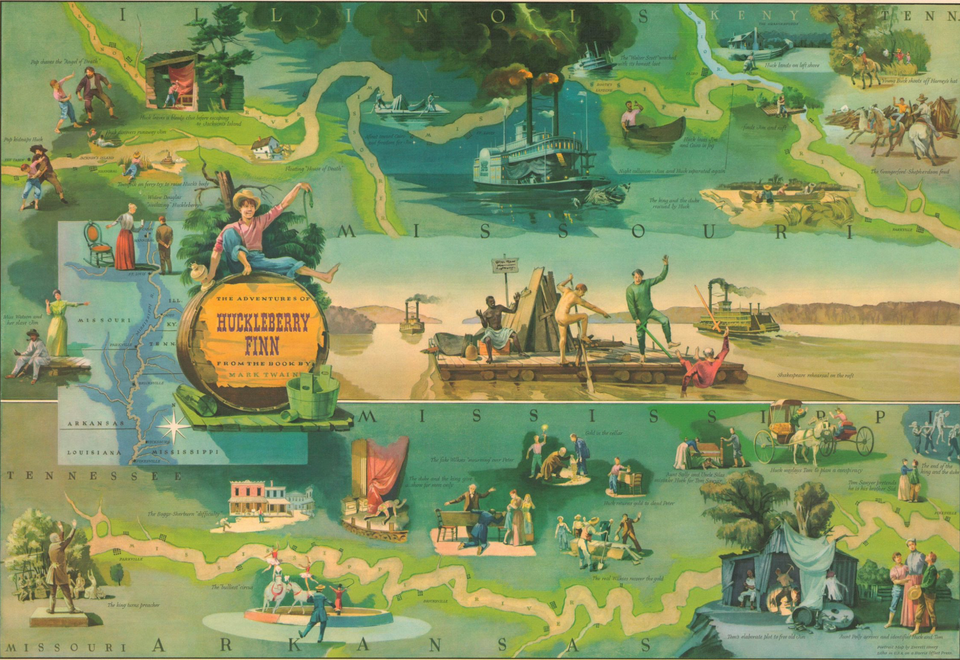
The River and the Story
The Adventures of Huckleberry Finn begins in a small fictional town called St. Petersburg, Missouri — modelled closely on Hannibal, Missouri, where Mark Twain himself grew up on the western bank of the Mississippi River. From there, the story flows south, carried by the current of America's greatest river, through landscapes, moral dilemmas, and encounters that together form one of the most enduring novels in the English language.
At its surface, Huck Finn is a simple adventure story. A boy fakes his own death to escape his abusive, alcoholic father. He finds a runaway slave named Jim hiding on Jackson's Island — a sandbar sitting in the Mississippi just off the shores of St. Petersburg — and together they build a raft and drift south toward Cairo, Illinois, where the Ohio River branches eastward into free states. If they can reach Cairo, Jim might find freedom. If they miss it, the current will carry them deeper into slave territory, deeper into danger.
They miss it. And the novel truly begins.
The geography is not incidental. Cairo sits at one of the most significant points on the American map — the precise confluence where the Ohio River meets the Mississippi, at the very southern tip of Illinois. North of Cairo lies freedom. South of Cairo lies the antebellum Deep South, where slavery is most entrenched, most violent, and most legally protected. By missing Cairo in the fog, Huck and Jim do not merely make a navigational error. They drift into the heart of everything the novel wants to examine.
The Mississippi itself is both backdrop and character. Wide, powerful, indifferent, and beautiful, the river represents freedom and danger simultaneously. On the raft, Huck and Jim exist in a kind of suspension — between slavery and liberty, between childhood and adulthood, between the broken society onshore and the open water where, briefly, none of its rules apply.
Huck and Tom: Two Boys, Two Worlds
To understand Huckleberry Finn, you must first understand Tom Sawyer — and the profound difference between them.
Tom Sawyer is Huck's best friend and, in many ways, his opposite. Tom comes from a comfortable, respectable, middle-class home. He is educated, well-fed, and socially accepted. He is also a dreamer of the most incorrigible kind, his imagination so saturated with romantic adventure novels — pirate stories, tales of knights and highwaymen, tales of noble bandits — that he cannot experience reality without filtering it through fiction.
In the opening chapters, Tom assembles his friends into a "robbers gang" with elaborate rules about murdering and ransoming their victims. The gang's fearsome debut raid turns out to be an attack on a Sunday school picnic of small children. Tom looks at that dusty road and genuinely sees Spanish merchants and Arab soldiers with elephants and camels loaded with diamonds. His imagination is so powerful it overrides what is actually in front of him.
Huck looks at the same road and sees children with sandwiches.
That contrast — between Tom's romantic fantasy and Huck's grounded perception of reality — runs through the entire novel. Tom lives inside a story he has borrowed from books. Huck lives in the world as it actually is: dangerous, unjust, sometimes beautiful, and completely indifferent to narrative convention.
This difference has moral consequences. Tom can afford fantasy because his comfortable life insulates him from genuine risk. Huck cannot afford fantasy because he has a violent father, no money, no legal protection, and a friend whose freedom and life depend on clear-eyed decision making. When the stakes are real, Huck sees clearly. When Tom appears again later in the novel — and he does — his romantic games collide with real human suffering in a way that is both darkly comic and genuinely troubling.
Twain uses this contrast to make a quiet but devastating argument: the romanticisation of life, the preference for noble-sounding fiction over honest reality, is not merely foolish. In a society built on injustice, it is morally dangerous.
The Language of the River
One of the first things a careful reader notices about Huck Finn is that the grammar is wrong. Persistently, systematically, gloriously wrong.
"We was." "It warn't so." "I didn't mean no harm." "I'll learn you." These are not accidents or oversights. They are among the most deliberate and sophisticated choices Twain ever made as a writer.
Twain gave different characters distinct dialects — Huck's rural Missouri speech, Jim's African American Vernacular English, the more refined speech of educated characters like Judge Thatcher — and reproduced each with extraordinary precision. In a note at the beginning of the book, he even listed the dialects he used, almost like a linguist annotating a field study. What sounds like careless writing is in fact a feat of careful listening.
"We was" instead of "we were." "Warn't" instead of "wasn't" — a phonetic spelling that captures exactly how the word sounded coming from Huck's mouth in rural Missouri. Double negatives everywhere: "I ain't got nothing," "don't know nobody" — not logical contradictions but emphatic intensifiers, the natural grammar of spoken English that existed long before schoolroom rules tried to eliminate it. Many major languages, including French and Spanish, use double negatives as grammatically correct forms. The rule against them in English is arguably more about social class and prestige than pure logic.
Then there are the idioms. "By-and-by" — after a while, eventually, with no urgency, the perfect phrase for two people drifting on a raft with nowhere particular to be. "Out of spite" — doing something purely to wound another person, not because you want the thing itself. "Ornery" — stubborn, irritable, difficult, a word descended from "ordinary" through the drift of rural speech. "Crick" for creek. "Wigwam" for their rough shelter on the raft.
These are not decorations. Each word choice is a precise act of characterisation. You know who Huck is from the first sentence he speaks, before Twain has described a single physical feature. The language is the character.
The Man Behind the Voice
Samuel Langhorne Clemens — Mark Twain — was born in 1835 in Florida, Missouri, and grew up in Hannibal on the Mississippi. The river shaped him before he ever thought of becoming a writer.
As a young man Twain worked as a riverboat pilot on the Mississippi, one of the most demanding and prestigious occupations of the era. A pilot needed to memorise every bend, sandbar, snag, and depth variation along hundreds of miles of constantly shifting river — by day and by night, in all weather and all seasons. It required extraordinary powers of observation and memory. It also placed Twain at the centre of a rich, diverse, fast-moving world: merchants, gamblers, conmen, freed slaves, wealthy planters, frontier settlers, all passing through the arteries of a continent in motion.
Twain absorbed it all. Years later, when he came to write the Mississippi River into fiction, he was not imagining a landscape. He was drawing from memory with the precision of a man who had once staked lives on knowing exactly where the bottom was.
Before the riverboats, there was journalism. Twain worked as a newspaper journalist in Missouri, Nevada, and California during the Gold Rush era — writing fast, under deadline pressure, for audiences who would not tolerate dullness. That discipline built his prose. Journalism demanded clarity, economy, and the ability to make a point quickly and memorably. It also placed him inside a world saturated with frontier con artists, traveling theatrical frauds, failed prospectors, and opportunists of every description — the raw material from which the King and the Duke would eventually emerge.
He was also, critically, a public speaker. For years Twain toured extensively as a lecturer and storyteller, performing live to paying audiences across America and eventually the world. He would tell stories, watch the audience's reactions in real time, and refine his timing, word choices, and rhythms based on what landed and what fell flat. That live feedback loop — the immediate human response to a joke or a pause or an unexpected turn — shaped his prose style more than any amount of solitary revision could have. Huck Finn reads like someone talking directly to you because Twain spent decades practising exactly that.
He read voraciously and widely. He was fascinated by history, science, and technology — a close friend of Nikola Tesla and an early enthusiast of the typewriter and telephone. He did not see literature and science as separate domains.
And he wrote by hand, on paper, crossing out and rewriting with a ferocity that his surviving manuscripts reveal clearly. Without a delete key, without word processing software, without any means of revision except striking through lines and scrawling new ones in the margins, Twain produced prose of extraordinary precision. The slower, more physical process of manuscript revision may have forced a deliberateness of thought that digital writing sometimes discourages. Every word that survived had to survive on its merits.
What Shaped Huck Finn
Several distinct streams fed into the novel.
The frontier oral tradition. Twain grew up inside a culture of campfire yarns, tall tales, and deadpan frontier humour that had its own precise architecture — the slow buildup, the comic deflation, the punchline that arrives sideways. He studied this tradition analytically and wrote about it explicitly in his essay "How to Tell a Story," distinguishing between the American humorous story, which he considered a genuine art form, and the merely witty or comic story. The Sunday school picnic scene, Pap's philosophical defence of chicken theft, the King and the Duke's theatrical frauds — all of these have the DNA of frontier joke-telling refined into something far larger and more serious.
The river world's con artists. The King and the Duke — two itinerant fraudsters who attach themselves to Huck and Jim and exploit every situation they encounter — were drawn from life. The frontier and post-Civil War South were genuinely thick with confidence men, fake theatrical troupes, fraudulent revivalists, and swindlers targeting isolated rural communities with weak law enforcement and limited access to outside information. Twain witnessed this culture directly during his Nevada and California years. The Royal Nonesuch — a theatrical scam in which audiences too embarrassed to admit they'd been fooled pressure others into attending, spreading the humiliation — mirrors real documented schemes of the era.
Shakespeare and classical literature. The embedded theatrical performances in Huck Finn, the feuding families of the Grangerford-Shepherdson section, the themes of appearance masking reality — all carry the fingerprints of Shakespeare. Don Quixote's influence is visible in Tom Sawyer, whose romantic fantasies collide with mundane reality in ways that echo Cervantes' knight. The picaresque tradition — a wandering hero moving through different social worlds, exposing their hypocrisies through innocent or outsider eyes — structures the entire novel.
The Bible and American religion. Scripture runs through Huck Finn constantly, always ironised, always held against the behaviour of those who quote it. The Grangerfords go to church carrying guns and listen to sermons about brotherly love before walking out ready to kill their neighbours. Pap invokes honest, generous principles to justify stealing chickens. The respectable world of religion and the actual behaviour of its adherents are shown in permanent, devastating contradiction.
Walter Scott and the romanticism Twain despised. Naming a rotting, dangerous, sinking steamboat "the Walter Scott" was no accident. Twain held the Scottish romantic novelist Sir Walter Scott partly responsible for what he saw as the South's fatal self-delusion — its belief, fed by Scott's glorified tales of chivalry and aristocracy, that it was a noble, honourable civilisation rather than a society built on brutal exploitation. The most unchivalric institution imaginable — slavery — was defended by people who thought of themselves as romantic knights of honour. Twain despised that gap between self-image and reality more than almost anything else. Huck Finn is in part a sustained assault on it.
The Moral Heart
Beneath the comedy, the dialect, the adventure, and the social satire, Huck Finn is a novel about one boy's moral education — conducted entirely outside the institutions that are supposed to provide it.
Jim is legally property. The law of the entire United States, including free states under the Fugitive Slave Act of 1850, requires that escaped slaves be returned to their owners regardless of where they are found. Helping Jim is a serious crime. Huck knows this. He has been told his whole life — by the Widow Douglas, by Sunday school, by the society around him — that helping a runaway slave is wrong, sinful, damnable.
And yet.
Over hundreds of miles of river, Huck comes to know Jim not as property but as a person. A man of dignity, intelligence, humour, and profound feeling. A father who loves his children. A friend who watches over Huck while he sleeps. Jim wins philosophical arguments with pure reasoning. He navigates danger with resourcefulness and courage. He is, in every meaningful human sense, more than the law says he is.
Twain never once writes that slavery is evil. He doesn't need to. He simply shows you Jim.
The novel's deepest irony is that every adult institution in Huck's world — the church, the law, respectable society, family — fails him and fails Jim completely. The court system cannot protect a boy from his own violent father. The church's morality coexists comfortably with murder and exploitation. Respectable people own slaves and quote scripture in the same breath.
Against all of that, a barefoot, barely literate thirteen-year-old on a raft arrives at a more genuine moral understanding than any of them — not through education or religion, but through direct human experience. Through knowing one person completely enough to see their full humanity.
That is Twain's most radical and enduring argument. Not delivered in a speech, not written in an essay, but shown — quietly, precisely, and unforgettably — in the relationship between a boy and the man the law said was not a man.
A Final Note on Language
Ernest Hemingway wrote in 1935 that all modern American literature comes from one book by Mark Twain called Huckleberry Finn. He called it the best book America had produced.
He was not wrong.
Twain invented something genuinely new — an American literary voice that was plain, direct, vernacular, morally serious beneath its comedy, and completely unlike anything that had existed before it. He did it by listening. By absorbing decades of how real people actually talked, thought, argued, laughed, and survived. By trusting that the speech of an uneducated river boy was worthy of literature. By understanding that how someone speaks is who they are.
"We was." "It warn't so." "By-and-by."
Wrong by the rules. Right in every way that matters.